“Football is a simple game; 22 men chase a ball for 90 minutes and at the end the Germans win." -- Gary Lineker, circa 1990
Watch the highlights here.
Monday, June 28, 2010


Friday, June 25, 2010
My country, 'Tis of thee
What struck Spore Sprout most about the otherwise forgettable match between France and Mexico (Group A June 17) was at the beginning when La Marseillaise was played. As the camera panned across the faces of the France players, some singing the national anthem and some not, millions of television viewers could see tears streaming down the face of Patrice Evra, the captain of France.
Why the tears and emotion? Spore Sprout thinks he knows.
Patrice is a self-made Frenchman, in that he chose to be French (over being Senegalese). Is it any surprise that a man who chose his nationality could love it more than another born willy nilly into it?
Similarly, Jong Tae-se 张大世, captain of the North Korea team who is a South Korean by descent, born and bred and living and working in Japan, chose to be a citizen of North Korea. He cried when the North Korea national anthem was played before the match with Brazil (Group G June 15).

This is how Guillermo Franco (a former Argentine citizen who plays for Mexico) put it:
Why the tears and emotion? Spore Sprout thinks he knows.
Patrice is a self-made Frenchman, in that he chose to be French (over being Senegalese). Is it any surprise that a man who chose his nationality could love it more than another born willy nilly into it?
Similarly, Jong Tae-se 张大世, captain of the North Korea team who is a South Korean by descent, born and bred and living and working in Japan, chose to be a citizen of North Korea. He cried when the North Korea national anthem was played before the match with Brazil (Group G June 15).

This is how Guillermo Franco (a former Argentine citizen who plays for Mexico) put it:
I'm Mexican. I feel 100 percent Mexican since the day I was naturalized. I made the decision to be Mexican. I didn't decide where I was born -- God made that decision. But I made the decision to become Mexican and I feel proud of that. The opportunities that country has shown me, the love -- there are a lot of reasons why I tipped my heart towards Mexico.Do we forget something important when we criticize our sportsmen and sportswomen who are new compatriots for being less than "true blue Singaporean"?
The other side of leadership
Coach Marcello Lippi following Italy's ignominous exit (as holders!) from the group stage of World Cup 2010:

I take full responsibility... If a team shows up at an important game with terror in its heart and head and legs, it must mean the coach did not train them as he should have done. I thought the men I chose would have been able to deliver something different but obviously I was wrong.
The players didn't play right, they didn't press, they didn't build, they didn't do anything. I still have belief in the players but no one would believe that was the real Italian team, the one you saw out there. I don't want to play the victim but the leader is always responsible. I refuse to believe we are as bad as you saw tonight – I didn't think we would win the World Cup but I thought we could perform better than that – but this is clearly not a fantastic moment for Italian football.
I deeply regret not being able to prepare the team properly or find the right mix of motivation. I don't know why we only played in the last 10 minutes and I am sorry for the choices I made, what else can I say? I am extremely sorry for all the fans who came to watch us, and I can hardly express how sorry I am to end my time with the association in this way. I really would have expected anything but this.

Photograph: Filippo Monteforte/AFP/Getty Images
Thursday, June 24, 2010
Team spirit
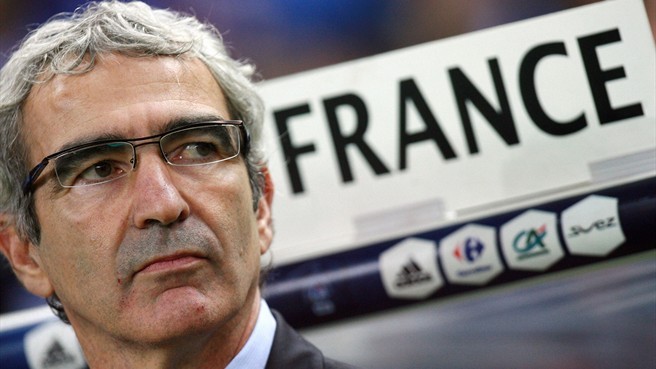
The strike was organized to protest the sending-home by the French football authorities of a player who had verbally abused the coach in an expletive-laden rant and then refused to apologize. The team captain spoke ominously of "traitors" in the dressing room and clashed with the assistant coach, who then quit. Several senior members of the squad were identified in the press as "gang-leaders" agitating against the coach. A government minister called the behavior of the players "appalling."
Similar troubles brewing in Team England bubbled to the surface when the former captain, recently removed for an extra-marital affair with a teammate's fiancee, complained in a press conference about squad selection and other mis-handlings of football matters by the coach. Several senior members of the squad were identified as being unhappy, who promptly denied his allegations, notwithstanding their recent complaints in the press about the monotony of their training regime.
France promptly crashed out of the group stage of the world cup finals, and England squeezed through on the back of a squeaker.
Many spectators, like Spore Sprout, feel that such dismal results are only to be expected when teams are dysfunctional. But which is the chicken and which the egg? Steve Archibald may well have a point when he famously called team spirit an illusion brought on by victory.
Tuesday, June 22, 2010
World Cup 2010
The world cup is a festive occasion around the Sprout household. What serious fun to watch twenty men kick a ball about on television (!) -- and cheer along with the very lucky tens of thousands inside the stadium where you wish you were, also along with the lucky hundreds of millions gathered around screens just like you are. How precious to share some of football's unforgettable moments with friends and family and in happy fellowship with people all over the world.
Spore Sprout learns a few things along the way, too, quite apart from the odd geography lesson, such as that both Paraguay and Slovakia (Group F June 21) are located at the center of their respective continents.
Watching the Argentina v. South Korea game (Group B June 17) in China, the word that came to Spore Sprout's mind was 大气 (loosely understood as a generosity that is often artless, in contrast to 小气, a calculative petty-mindedness).
Three things gave Spore Sprout this impression. First, all sixty-four matches of World Cup 2010 are broadcast live and replayed several times in different guises on public television in China -- free to all viewers in China. Contrast this with our lot in Singapore: games available only to cable-TV subscribers, and at historic high rates (S$94.16 for existing subscribers; higher for new subscribers). Spore Sprout thinks he understands most of the arguments made to explain why things are the way they are in Singapore ... But he asks, "Why not be BIG about it?"
Second, notwithstanding popular sentiments against what is seen as repeated Korean attempts to appropriate certain elements of Chinese culture and tradition (e.g., Ganjeung Danojie, the Korean variant of the Duanwujie dragonboat festival that originated in China, was designated as a Korean cultural heritage by UNESCO in 2005), the Chinese TV commentary for the game in which Korea was soundly beaten betrayed no hint of snide gloating, but consistently praised the Korean team as worthy representatives of Asian football, a shining example for China to emulate.
Third, it was heartwarming to be reminded of how the magnanimity of one person can mean so much to another. The Korean goal that took the shine off the Argentine victory was clearly the fault of Argentine defender Martin Demichelis whose cringing mistake could have been expected to send his hot-tempered coach Diego Maradona into an apoplectic fit. In the words of Demichelis,
Vamos, Vamos a ganar ...

Spore Sprout learns a few things along the way, too, quite apart from the odd geography lesson, such as that both Paraguay and Slovakia (Group F June 21) are located at the center of their respective continents.
Watching the Argentina v. South Korea game (Group B June 17) in China, the word that came to Spore Sprout's mind was 大气 (loosely understood as a generosity that is often artless, in contrast to 小气, a calculative petty-mindedness).
Three things gave Spore Sprout this impression. First, all sixty-four matches of World Cup 2010 are broadcast live and replayed several times in different guises on public television in China -- free to all viewers in China. Contrast this with our lot in Singapore: games available only to cable-TV subscribers, and at historic high rates (S$94.16 for existing subscribers; higher for new subscribers). Spore Sprout thinks he understands most of the arguments made to explain why things are the way they are in Singapore ... But he asks, "Why not be BIG about it?"
Second, notwithstanding popular sentiments against what is seen as repeated Korean attempts to appropriate certain elements of Chinese culture and tradition (e.g., Ganjeung Danojie, the Korean variant of the Duanwujie dragonboat festival that originated in China, was designated as a Korean cultural heritage by UNESCO in 2005), the Chinese TV commentary for the game in which Korea was soundly beaten betrayed no hint of snide gloating, but consistently praised the Korean team as worthy representatives of Asian football, a shining example for China to emulate.
Third, it was heartwarming to be reminded of how the magnanimity of one person can mean so much to another. The Korean goal that took the shine off the Argentine victory was clearly the fault of Argentine defender Martin Demichelis whose cringing mistake could have been expected to send his hot-tempered coach Diego Maradona into an apoplectic fit. In the words of Demichelis,
I felt that, for a moment after the error, I had earned the insults of 40 million Argentines. ... Maradona spoke to me a lot at half time, he told me I have his support and my team-mates'. He told me to not be overcome by nerves because of the error, to not start hitting long balls from the back and try to control the ball like always. It was an amazing show of support.Vamos, Vamos Argentina,
Vamos, Vamos a ganar ...

Photographed by: Alejandro Pagni/AFP/Getty Images
Saturday, June 12, 2010
The moral life of children
Spore Sprout has suspected it for a while, and now he is almost sure: that his ten-year-old has a more finely-tuned sense of morality than he does, a greater capacity for moral reasoning, a higher degree of moral intelligence.
Discussing their favorite characters from the Mahabharata, Spore Sprout explained why he thought Karna was heroic. Please see last post.
Making his case for Yudhishthira, Small Sprout recalled the Pandava prince's reaction to the Pandavas' victory over their kinsmen and the news of Karna's death. "We have murdered our brother," Yudhishthira was inconsolable. Small Sprout asked, half rhetorically, "Do you think Karna would have felt as sad if it was the other way around?" Spore Sprout said he thought not, and asked Small Sprout: "So Yudhishthira is the greater, because he loves his enemy?" "Yes." Spore Sprout must say that his son may have a point.
This brings to mind an earlier conversation between father and son when Small Sprout had just turned seven. The boy was learning about the "life cycle" in school. The father asked, "Why 'cycle'? Why not a life 'line' instead? How is life like the water cycle that you just learned about?" "Because life goes on after death -- like leaves falling after they grow and growing after they fall." "Is there a human life cycle?" "A man dies and his children and grandchildren live on." This enlarged sense of the self impressed Spore Sprout greatly.
Discussing their favorite characters from the Mahabharata, Spore Sprout explained why he thought Karna was heroic. Please see last post.
Making his case for Yudhishthira, Small Sprout recalled the Pandava prince's reaction to the Pandavas' victory over their kinsmen and the news of Karna's death. "We have murdered our brother," Yudhishthira was inconsolable. Small Sprout asked, half rhetorically, "Do you think Karna would have felt as sad if it was the other way around?" Spore Sprout said he thought not, and asked Small Sprout: "So Yudhishthira is the greater, because he loves his enemy?" "Yes." Spore Sprout must say that his son may have a point.
This brings to mind an earlier conversation between father and son when Small Sprout had just turned seven. The boy was learning about the "life cycle" in school. The father asked, "Why 'cycle'? Why not a life 'line' instead? How is life like the water cycle that you just learned about?" "Because life goes on after death -- like leaves falling after they grow and growing after they fall." "Is there a human life cycle?" "A man dies and his children and grandchildren live on." This enlarged sense of the self impressed Spore Sprout greatly.
Monday, June 7, 2010
Karna
Spore Sprout believes that no one is too young for good theater. Recently, he sat his ten-year-old and six-year-old down for five hours of Peter Brook's adaptation of The Mahabharata (albeit on DVD and abridged from the original nine hours of stage production).
.jpg)
The children wanted to discuss who each person's favorite character was, out of a cast of seeming hundreds. Spore Sprout nominated Karna (Boy Sprout chose Yudhishthira and Girl Sprout Kunti). They wanted to know the reasons for my choice -- why pick someone from the "other side" who fought against the hero Arjuna in his chariot driven by Krishna?
I explained that I thought Karna was heroic -- he was bigger than Life and more steadfast than Fate.
Karna was abandoned by his royal mother and raised by a chariot driver. When he tried to take part in a martial competition as befit his skills, he was mocked by Arjuna and the other princes and noblemen. Withdrawing in humiliation, Karna was called back by Duryodhana and granted title and land. (In a line that I am fond of, Duryodhana said: "Do not speak of Birth. Birth is obscure and men are like rivers whose origins are often unknown.") When Karna's true birth was revealed to him on the eve of battle as the first-born of the Pandava princes, he declined the proferred embrace of his brothers (and the attendant status, power and riches), but instead chose to remain loyal to Duryodhana, the Kaurava prince who had first shown him kindness. Karna went into the great battle and, unarmed and defenceless with his chariot wheel caught in the earth, was struck down finally, against the rules of battle and codes of honor, by Arjuna upon the urgings of Krishna.
.jpg)
The children wanted to discuss who each person's favorite character was, out of a cast of seeming hundreds. Spore Sprout nominated Karna (Boy Sprout chose Yudhishthira and Girl Sprout Kunti). They wanted to know the reasons for my choice -- why pick someone from the "other side" who fought against the hero Arjuna in his chariot driven by Krishna?
I explained that I thought Karna was heroic -- he was bigger than Life and more steadfast than Fate.
Karna was abandoned by his royal mother and raised by a chariot driver. When he tried to take part in a martial competition as befit his skills, he was mocked by Arjuna and the other princes and noblemen. Withdrawing in humiliation, Karna was called back by Duryodhana and granted title and land. (In a line that I am fond of, Duryodhana said: "Do not speak of Birth. Birth is obscure and men are like rivers whose origins are often unknown.") When Karna's true birth was revealed to him on the eve of battle as the first-born of the Pandava princes, he declined the proferred embrace of his brothers (and the attendant status, power and riches), but instead chose to remain loyal to Duryodhana, the Kaurava prince who had first shown him kindness. Karna went into the great battle and, unarmed and defenceless with his chariot wheel caught in the earth, was struck down finally, against the rules of battle and codes of honor, by Arjuna upon the urgings of Krishna.
ईश्वरः रहस्यमयरीतिमाचरति
Thursday, June 3, 2010
Paris in May
Spore Sprout arrived in Paris whereupon he purchased a copy of the Herald Tribune from a street vendor and had an instant photo of himself taken in a booth at a Metro station -- both felt like things that one would do with some relish in Paris.

When done with his chores for the day, Spore Sprout picked up a sandwich (ham, cheese, lettuce and tomato in a baguette), a bottle of cheap red wine and a chunk of fine dark chocolate studded with hazelnuts, almonds and raisins, for a very late lunch on his balcony. A fellow hotel-guest was smoking on an adjacent terrace as Spore Sprout set his table and consumed his meal, and Spore Sprout was glad to have company to share wine, conversation and a panoramic view of the city.

Liberté, égalité, fraternité partout dans le monde!


When done with his chores for the day, Spore Sprout picked up a sandwich (ham, cheese, lettuce and tomato in a baguette), a bottle of cheap red wine and a chunk of fine dark chocolate studded with hazelnuts, almonds and raisins, for a very late lunch on his balcony. A fellow hotel-guest was smoking on an adjacent terrace as Spore Sprout set his table and consumed his meal, and Spore Sprout was glad to have company to share wine, conversation and a panoramic view of the city.

Liberté, égalité, fraternité partout dans le monde!

Subscribe to:
Comments (Atom)
